

Daisymol Manjaly, 20 Sep 2025
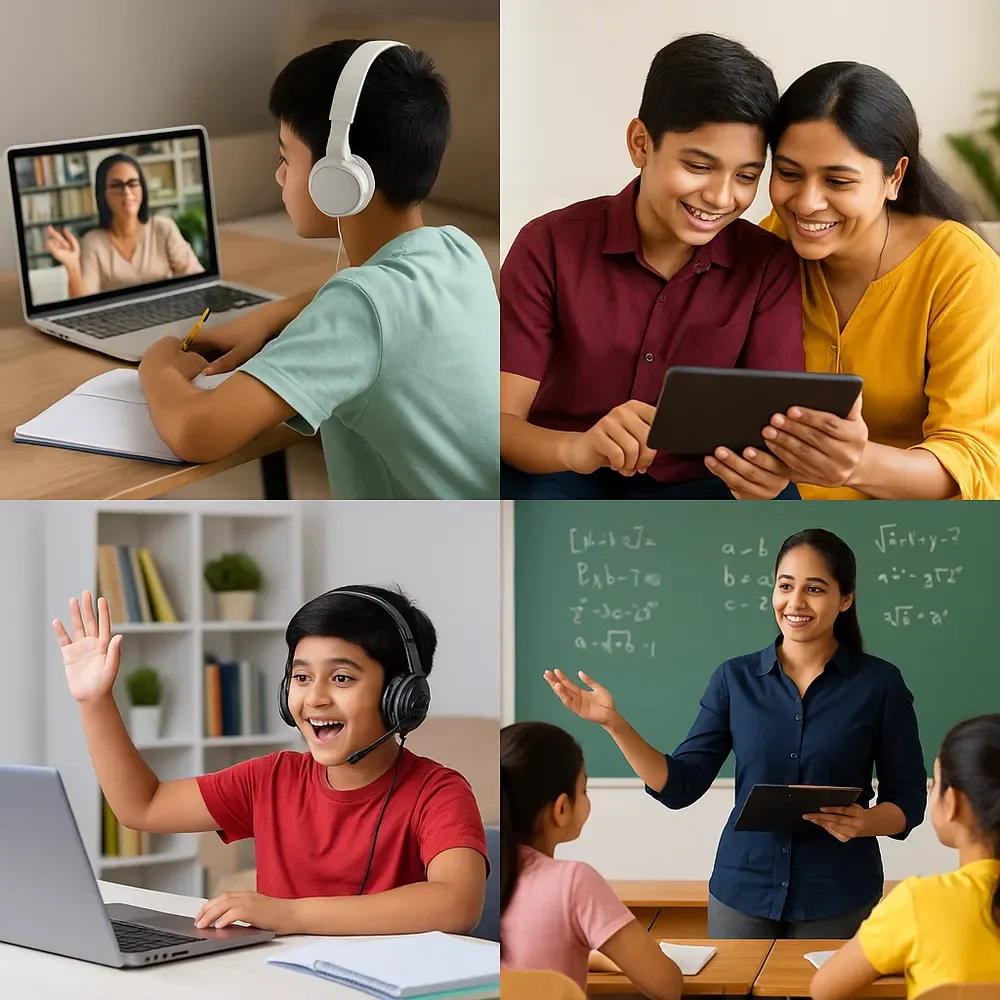
Recently, I came across an interesting article in The Hindu titled “Beyond videos: Why India’s EdTech must evolve from content to connection” by Atul Kumar. It argues that EdTech should invest in connection as much as in content. True learning, after all, involves interaction, adaptation, feedback, practice, and social reinforcement, and I agree.
The author points out that the Indian EdTech space must actively encourage affordable mentoring, peer-to-peer learning, live doubt resolution, and community-driven accountability, while also investing in richer, more relational learning architectures. This is exactly what we at QurioKid are working to build. Heidi and I are often asked how we can scale QurioKid, since we focus on one-to-one, personalized learning experiences. How do we reach more students while staying true to our approach?
Our vision is for mentors not to deliver one-time content, but to become long-term partners in a student’s learning. For example, if a child enrolls in QurioKid in Class 7, we want them to have access to the same set of mentors until they complete Class 10 or even Class 12. By building deeper connections with students, we create genuine relationships. As mentors, teachers, and educators, we understand their capabilities, individuality, and learning styles, and adapt our teaching to theirs. This builds deep learning that prepares children for exams and for the life that follows.
Relational personalization is equally important. Pushing data alone isn’t enough; matching learners with mentors, peer groups, or social support mechanisms that align with their learning style, pace, and goals matters most.
Many people treat high-quality content as the most important part of online learning. The EdTech industry has certainly improved in both content delivery and pedagogy compared to traditional methods. But the real question is this: Should we measure the success of online education in India by the number of hours students spend consuming extraordinary content, or by their ability to relate to and recall what they’ve learned?
We often come across ads that sell education packages for young children at ₹29, ₹49, or ₹99. It’s surprising to see how companies market these products, and how many parents buy them without asking whether they help their child or are simply a timepass and a waste of money. This system monetizes affordability while ignoring the child’s unique learning style. Scaling human connection costs more, needs more people and is harder to organise than video delivery, so many online courses fall into this trap.
This concern is especially relevant given the dropout rates for online courses, which can be as high as 85%. While there are many reasons why students drop out midway, two key issues stand out:
Illusion of Learning: Watching recorded content once or twice doesn’t mean a student has fully grasped the concept. True learning requires application: solving problems, working through quizzes, and connecting concepts to real life. Personal interaction with a mentor or teacher can change how a child learns.
Illusion of Equity: Every child is unique, yet companies make most online content for the masses rather than for the individual child. Actual learning needs vary, as do intelligence levels, styles, and contexts. Each student deserves a personalized approach.
Learners who can ask questions, get clarifications, and engage in discussions are more motivated, less likely to drop out, and more likely to persist in learning. A relationship with a coach, mentor, or peer group builds accountability and deeper engagement than self-study ever could. At QurioKid, we believe children develop critical thinking, problem-solving, communication, and creativity best through dialogue and relationships, rather than by watching videos.
These gaps made the two of us, Daisymol and Heidi, think hard about how we could create a solution. That’s how #QurioKid was born. We are one of the youngest education initiatives in India, just a few months old. While we may not have a large team to market QurioKid or its philosophy, we have a clear focus: to promote real learning, not the illusion of learning.
Ours is a hybrid model that combines scalable content (videos, quizzes, exercises) with on-demand interactive support, peer communities, and mentoring. Beyond one-on-one classes, we encourage our young learners to participate in peer-to-peer activities, discussion forums, and collaborative sessions to foster meaningful interactions with like-minded peers. Our aim is to prepare young learners for school and for life beyond it.
Written by Daisymol, Founder QurioKid
